
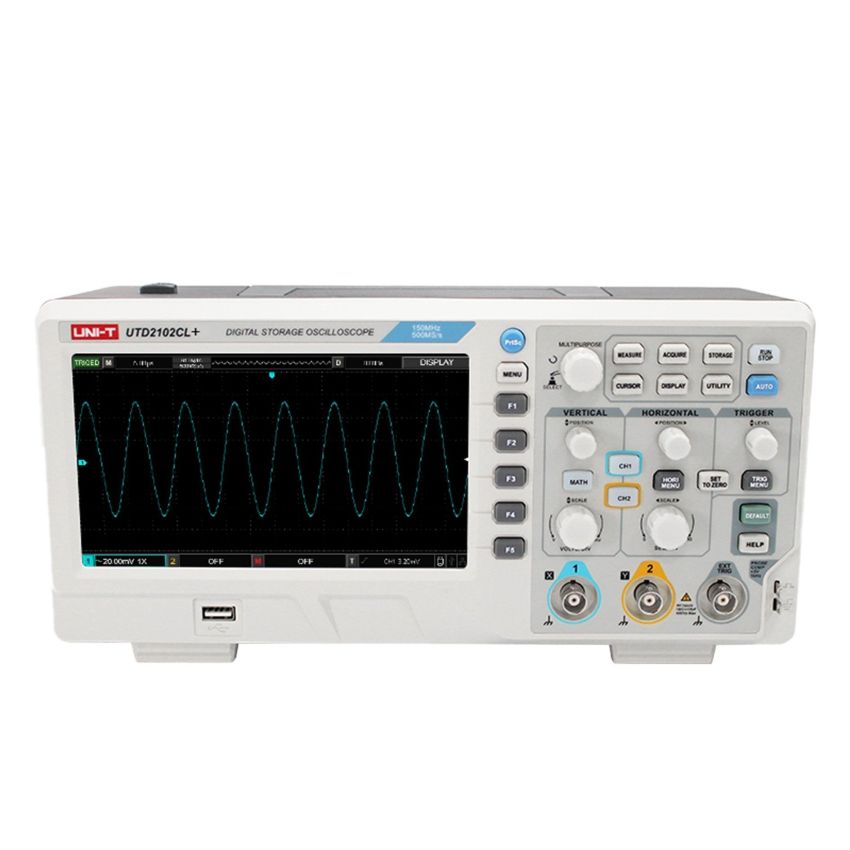
The UNI-T UTD2102CL+ is a high-performance, entry-level professional benchtop oscilloscope designed for accuracy, reliability, and ease of use. As an upgraded model in the legendary UTD2000 series, the "CL+" variant offers enhanced processing speed and a more intuitive user interface. Whether you are a student learning the fundamentals of electronics or an engineer debugging embedded systems, this 100MHz scope provides the precision required to visualize and analyze electrical signals with confidence.
The 7-inch widescreen display is a standout feature, providing 28 divisions of horizontal range—significantly more than standard scopes in this class. This extra screen real estate allows for better visualization of complex serial data or high-frequency noise. The device also includes a "Print Screen" button for one-touch data capture to a USB drive, making it easy to document findings for reports or further analysis.
Built for the modern workbench, the UTD2102CL+ is compact and lightweight without sacrificing industrial build quality. It features independent vertical scale knobs for each channel, reducing menu-diving and speeding up your workflow. With its integrated FFT spectral analysis and robust triggering system, this oscilloscope is an essential tool for anyone working with power electronics, audio equipment, or automotive sensors.
Key Features:
High-Speed Sampling: Delivers a 500MS/s real-time sampling rate and an equivalent sampling rate of 25GS/s to capture fast-moving transients and complex waveforms.
Large 7-Inch Color Display: Features a wide WVGA (800x480) TFT LCD screen, providing a crisp and clear view of overlapping waveforms and measurement data.
Deep Memory Depth: Equipped with a 64kpts storage depth, allowing for long-duration signal capture and detailed analysis of zoomed-in waveform sections.
34 Auto-Measurement Parameters: Automatically tracks and displays peak-to-peak voltage, frequency, rise time, duty cycle, and more to streamline the diagnostic process.
Advanced Triggering & Math: Includes Edge, Pulse, Video, and Alternate trigger modes, along with built-in mathematical functions (Add, Subtract, Multiply, Divide, and FFT).