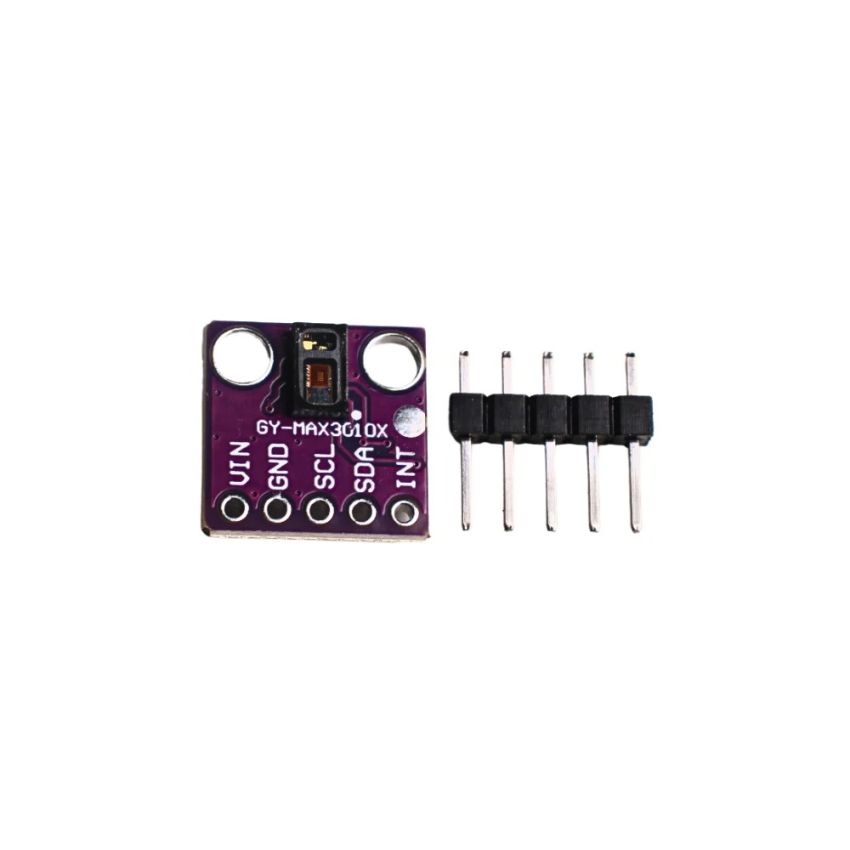
The GY-MAX30102 is a compact optical biosensor module designed to measure heart rate (PPG) and blood oxygen saturation (SpO₂) using red and infrared LEDs with a highly sensitive photodiode. It integrates Maxim Integrated’s MAX30102 chip, which combines LEDs, photodetectors, optical elements, and low-noise electronics into a single package optimized for wearable and medical-grade sensing applications.
This module communicates through the I²C digital interface, making it easy to connect with popular microcontrollers such as Arduino, Raspberry Pi, ESP32, STM32, and Jetson boards. Its onboard voltage regulation allows it to operate from 3.3 V or 5 V power inputs while maintaining the sensor’s required 1.8 V logic and LED drive levels.
The MAX30102 features programmable sample rates, LED currents, pulse widths, and FIFO buffers, enabling precise control over signal quality and power consumption. Its high signal-to-noise ratio allows accurate pulse and oxygen-level measurements even in compact, low-power designs such as wearable fitness trackers, medical monitors, IoT health devices, and DIY biomedical projects.
Key Features
- Dual wavelength optical sensing
- Uses red (660 nm) and infrared (880 nm) LEDs with a precision photodiode to measure both heart rate and blood oxygen saturation (SpO₂) accurately.
- I²C digital communication
- Supports standard I²C interface for easy integration with Arduino, Raspberry Pi, ESP32, and other microcontrollers.
- Low-power, high-accuracy design
- Built-in ambient light cancellation, low-noise analog front end, and programmable LED current for reliable readings with minimal power consumption.




 JORD
JORD