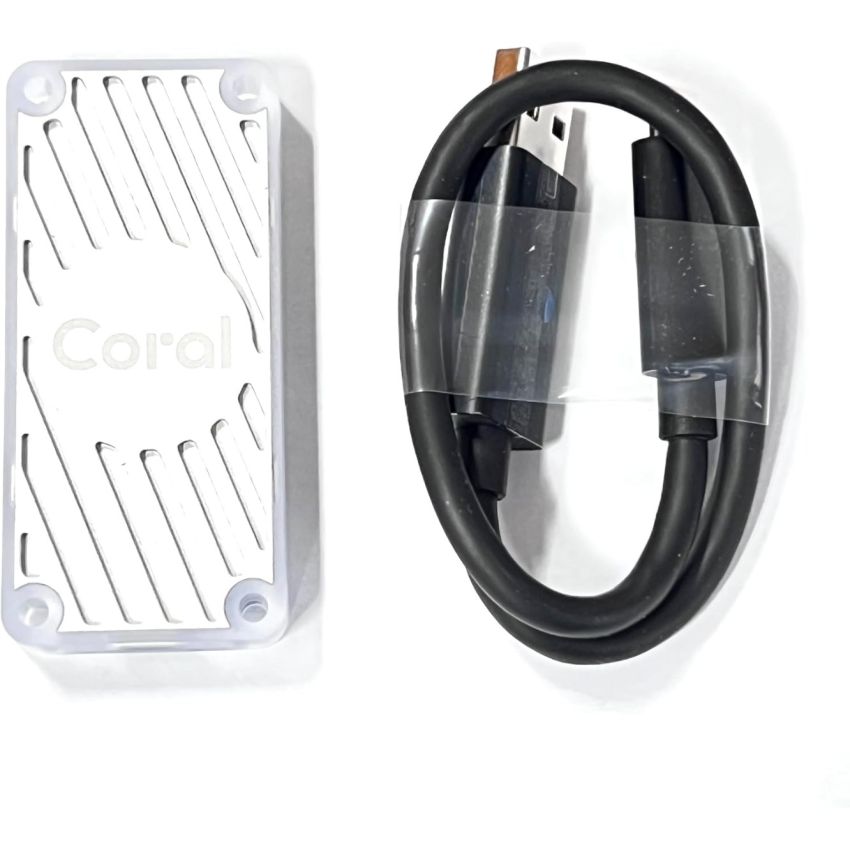
The Coral USB Accelerator is a powerful and compact AI co-processor designed to bring high-speed machine learning capabilities to your existing systems. Powered by Google’s Edge TPU, this device enables real-time AI inference directly on your device without relying on cloud processing, ensuring low latency, enhanced data privacy, and efficient performance.
By simply connecting via USB, the Coral USB Accelerator instantly upgrades your system into an AI-capable platform, making it ideal for developers, engineers, and researchers working on computer vision, robotics, smart automation, and edge AI applications. It is fully compatible with popular platforms such as Raspberry Pi, Linux, Windows, and macOS, making integration seamless across multiple environments.
With its ability to process up to 4 trillion operations per second (TOPS), the Coral USB Accelerator significantly accelerates TensorFlow Lite models, enabling advanced applications like object detection, face recognition, and real-time video analytics. The device is designed for efficiency, delivering high performance at low power consumption, making it perfect for embedded and edge computing projects.
Its compact form factor, plug-and-play functionality, and broad compatibility make it an essential tool for anyone looking to build scalable AI solutions without the complexity of high-end GPU systems. Whether you're developing smart surveillance systems, AI-powered IoT solutions, or robotics applications, this accelerator provides a reliable and efficient solution.
Key Features:
Powered by Google Edge TPU delivering up to 4 TOPS AI performance for fast and efficient machine learning inference
Plug-and-play USB 3.0 interface enables quick integration with Raspberry Pi, PCs, and embedded systems.
Supports TensorFlow Lite models, making it ideal for computer vision and edge AI applications.
Low power consumption design (~2W) ensures efficient operation for embedded and continuous workloads.
Compatible with Linux, Windows, and macOS platforms, providing flexibility across development environments.
Enables real-time AI processing without cloud dependency, improving privacy and reducing latency.




 JORD
JORD